Introducing Rye for Rewards: Native Catalog Redemption for Rewards Programs
Arjun Bhargava
Co-founder and CEO @ Rye
9 minutes read
Native catalog redemption for credit card rewards programs and loyalty apps — built on Rye.
TL;DR / Key Takeaways
Today we're shipping Rye for Rewards — a source-available React component library for credit card rewards programs, points-based loyalty apps, and shopping-rewards and cashback platforms.
Rewards programs have spent a decade renting their redemption experience to affiliate networks. The shopper leaves the rewards app, the experience hands off to the merchant's site, and a measurable share of intended transactions never come back.
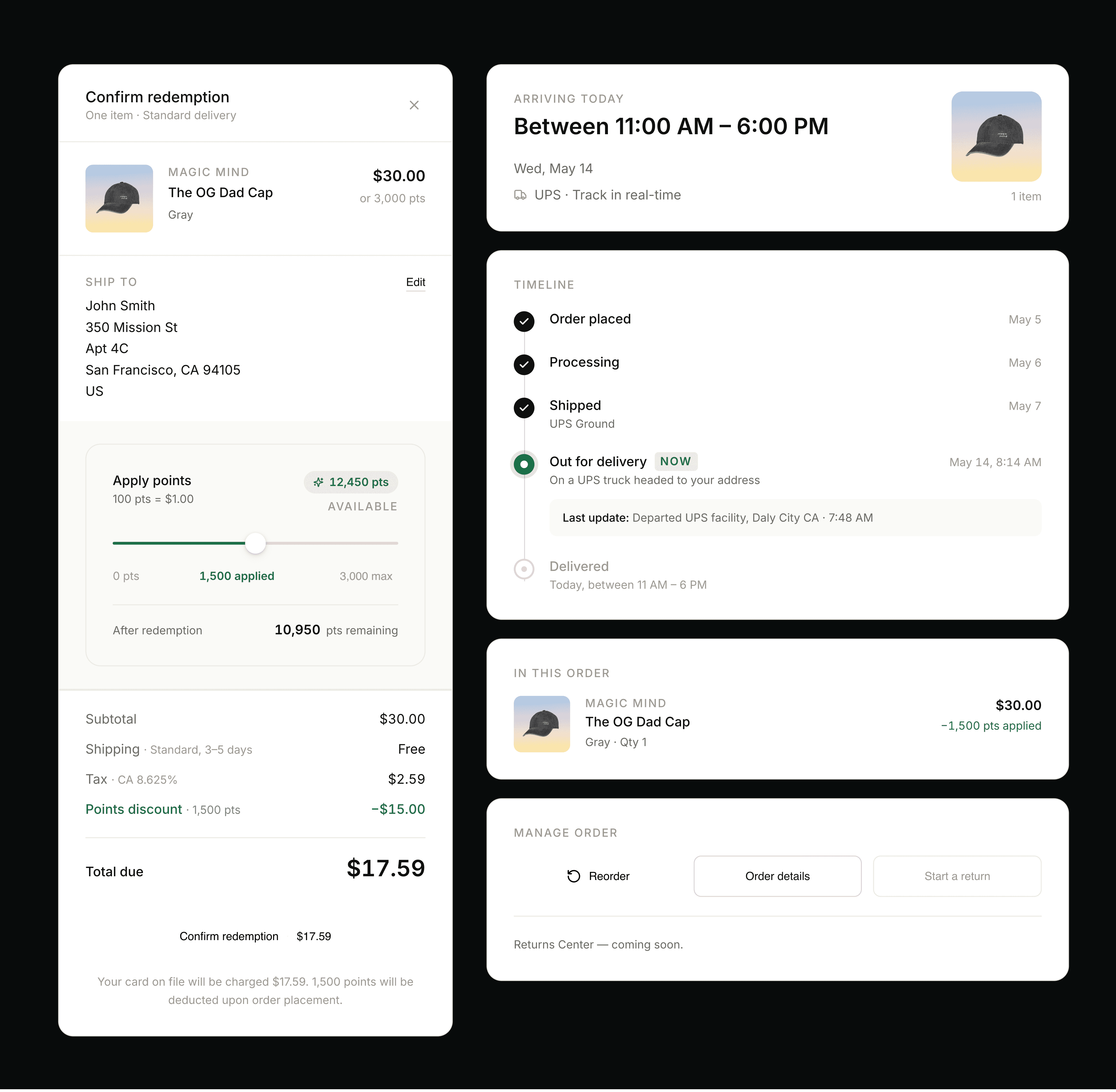
Native catalog redemption keeps the entire flow — catalog, PDP, payment, points, order tracking, returns — inside the rewards app, against one programmatic catalog, with the rewards platform as merchant of record.
Rye for Rewards ships seven components installed via the Shadcn CLI against registry.rye.com. Components are copied into the partner's repo: source-available, partner-themed, partner-owned.
Underneath: one API for 1M+ products across thousands of merchants, 260+ directly-connected commissioned merchants growing ~50/month, 14–17.5% developer commission with Instant Payout on Shopify-connected orders.
Explore Rye for Rewards · Read the docs →
Rewards programs have always been commerce products in disguise. A consumer earns points, opens an app, picks a brand, and tries to spend. Whether the points are airline miles, credit card cashback, employer recognition tokens, or corporate gifting balances, the shape of the flow is the same — and so is the architecture underneath it.
For most rewards platforms today, that architecture stops at the redemption boundary. The catalog is rented from an affiliate network. The product detail page lives on the merchant's site. The shopper leaves the rewards app, hands off to a hosted iframe or off-site redirect, and the rewards program loses control of the experience exactly when the experience matters most.
Today we're shipping Rye for Rewards — a source-available React component library that closes that boundary. The full redemption experience — catalog, PDP, payment, points application, order tracking, returns — lives inside the partner's app, themed by the partner, built on Rye's Universal Checkout API and Product Data API.
Every rewards program is now a commerce product.
Where Rewards Programs Are Today
A typical points-redemption flow today looks like this:
Shopper browses the rewards catalog inside the app — sourced from an affiliate network's product feed.
Shopper taps a product. The app hands off — a webview, sometimes a full external redirect — to the merchant's PDP.
Shopper sees a merchant-branded page that doesn't match the rewards program's design system. Pricing may differ from the catalog. Inventory may be stale.
Shopper completes the purchase on the merchant's site — or doesn't.
The affiliate network captures attribution via cookies or click IDs and pays the rewards platform on a 30-to-90-day cycle.
Returns, refunds, and customer support flow through the merchant — outside the rewards app's reach.
Every hop is a drop. The redirect from app to webview loses shoppers. The mismatch in design language confuses them. Stale inventory and pricing erode trust. Cookie-based attribution loses cross-device traffic. By the time a problem surfaces — a wrong item, a delayed shipment, a refund request — the shopper is dealing with a brand they didn't intend to interact with, and the rewards platform has no operational visibility into the order.
This made sense in 2015. In 2026, every other consumer surface has a native checkout experience. Rewards programs are some of the last apps where the buy button sends you elsewhere.
Native Catalog Redemption
The category name for the alternative is native catalog redemption. The entire redemption flow runs inside the rewards app, against one programmatic catalog, with the rewards platform as the merchant of record and the operational owner of the order.
The affiliate model gave rewards programs broad merchant coverage from a single integration, with no inventory management or fulfillment overhead. Native catalog redemption keeps those properties: one API for the catalog, components that install in days.
Affiliate-Redirect Rewards Programs | Native Catalog Rewards Programs |
|---|---|
Where the purchase completes: Merchant site after a redirect. | Inside the rewards app. Native checkout flow. |
Inventory model: Per-brand affiliate integrations + ad-hoc feeds. | One catalog API, 1M+ products across thousands of merchants. |
Redemption UI: Hosted iframes, off-site redirects, or merchant-hosted PDPs. | Source-available React components, owned and themed by the partner. |
New brand onboarding: Per-brand contracts and integrations. | Available the moment they enter the catalog. |
Attribution + reconciliation: Multi-network reconciliation across affiliates. | One ledger, one reconciliation, backend attribution. |
Commission cadence: Net-30 to Net-90 affiliate cycles. | Instant Payout at checkout on eligible merchants. |
For a deeper treatment of how commission economics work in agent-mediated commerce overall, see Affiliate Commissions in Agentic Commerce. For the developer-level mechanics of Instant Payout commission timing and the merchant catalog itself, see Building on Rye's Commissioned Merchant Catalog.
Introducing Rye for Rewards
How It's Built
A few principles shape how the library behaves at runtime.
No API client at runtime. Components don't import Rye API clients. Data flows in through props and callbacks; the partner's backend handles all Rye API communication. The frontend never sees a Rye API key. Authentication, caching, retries, and rate-limiting all sit in the partner's backend where they belong.
Partner as merchant of record. Rye operates as the commerce layer between the partner and the underlying merchants. The partner is the merchant of record on every order — they own the customer relationship, the receipt, the support thread, and the data.
Canonical Universal Checkout shapes. Every component consumes the same data shapes the Universal Checkout API returns: Buyer, Money, Product, address objects, line items. Data flows from Rye's API to the partner's backend to the component without remapping.
Theme-aware by default. Every visual decision is exposed as a CSS custom property token. Drop the partner's design tokens at the root and the components match. No fork required.
Stack. React 19, TypeScript strict mode, Tailwind v4, Base UI primitives for accessibility, Lucide for icons. Because the components ship as source — not a compiled package — partners on Vue, Svelte, React Native, or a different stack entirely can have a coding agent (Claude Code, Cursor, Copilot) port the library in a session.
The Catalog Underneath
Rye for Rewards is built on the same catalog every other Rye product uses. The shape of that catalog is what makes the native model viable for a rewards platform:
1M+ products across thousands of merchants accessible through one API.
260+ directly-connected merchants in the commissioned catalog, growing ~50/month — new brands are queryable the moment they enter the catalog, no per-partner contract required.
14–17.5% developer commission on Shopify-connected commissioned merchants, Instant Payout at the moment the order is placed.
For a rewards platform, that commission is a strategic lever — keep it as margin, pass it through to the shopper as boosted cashback or a discount, or split it. The choice is the platform's, not the affiliate network's.
Who This Is For
Three categories of partners are the natural fit:
Credit card rewards programs. Issuers and co-brands moving redemption inside the card app — replacing affiliate marketplaces with native catalogs the cardholder never has to leave.
Points-based loyalty apps. Airline, hotel, retail, and grocery loyalty programs that want a single in-app redemption surface across hundreds of brand partners.
Shopping-rewards and cashback apps. Marketplace cashback platforms, browser-extension rewards, and shopping companions where the purchase needs to complete inside the app.
Frequently Asked Questions
What is native catalog redemption?
Native catalog redemption is the architecture where a rewards program's entire redemption flow — catalog browsing, product detail pages, payment, points application, order tracking, and returns — runs inside the rewards app itself, against a single programmatic catalog. The rewards platform is the merchant of record on every order. There are no redirects to external merchant sites, no hosted iframes, and no per-brand integrations to maintain.
How is native catalog redemption different from affiliate-link redemption programs?
Affiliate-link redemption hands the shopper off to a merchant's website after a click. The merchant runs the checkout, the affiliate network handles attribution via cookies or click IDs, and the rewards platform reconciles commissions on a 30-to-90-day cycle. Native catalog redemption keeps the checkout inside the rewards app via a programmatic catalog API. The rewards platform owns the order, the brand experience, and the support relationship. On Shopify-connected commissioned merchants, commissions are paid at the moment the order is placed.
Who is the merchant of record in a native catalog redemption program?
The rewards platform. With Rye for Rewards, the partner is the merchant of record on every order — they own the receipt, the customer relationship, and the support thread. Rye operates as the commerce layer between the partner and the underlying merchants, handling order routing, payment processing, fulfillment coordination, and returns.
How do commissions and timing work when redemption happens inside the rewards app?
On Shopify-connected commissioned merchants — currently 260+ and growing by ~50 each month — the developer commission is 14–17.5%, Instant Payout at the moment the order is placed. On non-Shopify merchants, commissions flow on the merchant agreement's cadence, typically Net-30 to Net-90. The full developer treatment lives in Building on Rye's Commissioned Merchant Catalog.
Can a rewards platform pass through commissions to the shopper as cashback or a discount?
Yes. The commission flows to the rewards platform's account; the platform decides whether to keep it as margin, pass it through to the shopper as a discount or boosted cashback, or split it. Rye for Rewards' PayWithPoints component supports points-as-tender, cash-plus-points, and discount passthrough out of the box.
How long does it take to integrate Rye for Rewards?
A working flow ships within a week for partners with an existing rewards app. Components install via a single CLI command into the partner's repo. The frontend is theme-aware on day one; the backend wires through callbacks to the Universal Checkout API. Because components are copied as source rather than imported as a compiled package, partners can extend or customize without forking a dependency.
Start Building
Rewards programs are commerce products. The architecture should match.
Explore Rye for Rewards at rye.com/products/rye-for-rewards
Read the docs at rye.com/docs/rewards/introduction
Get an API key at console.rye.com